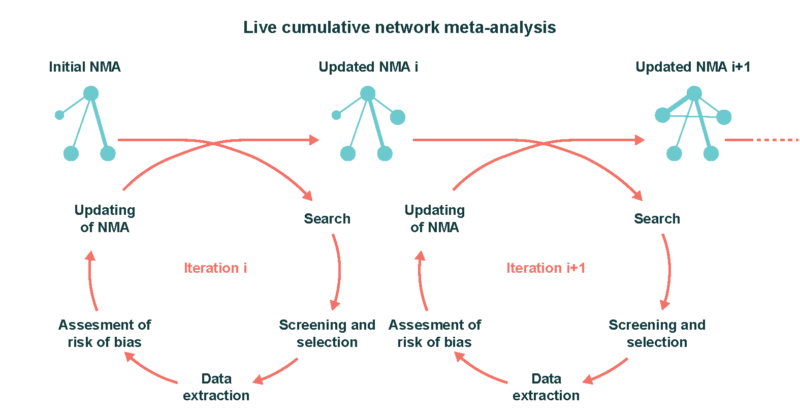
We aim to include novel treatments successively into our living NMA, an adaptive search strategy will be created to continuously cover all available second-line treatments for advanced NSCLC.
Should you like to report new treatments that were not taken into account.
A new framework called “Living NMA”
A paradigmatic shift for systematic reviews
Application to Non-Small-Cell Lung Cancer
We have started a living network meta-analysis of second-line treatments in advanced non-small cell lung cancer with wild-type or unknown status for epidermal growth factor receptor.
We chose this topic because:
- Non-small-cell lung cancer represents 85% of lung cancer and remains the leading cause of cancer-related death worldwide.
- Four second-line treatments (docetaxel, pemetrexed, erlotinib and gefitinib) are recommended in patients with an advanced NSCLC. But more than forty second-line treatments have been evaluated over the past decade and the number is continuously increasing. A new treatment is assessed in randomized trials every 3 months.
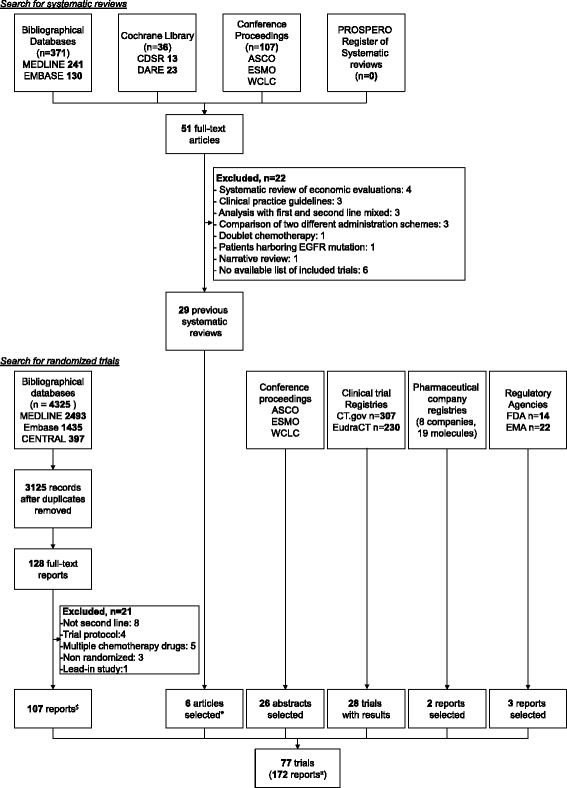
Search strategy
See details in Appendix 2 and 3 in the supplementary file
Flow chart: 77 trials (172 reports)
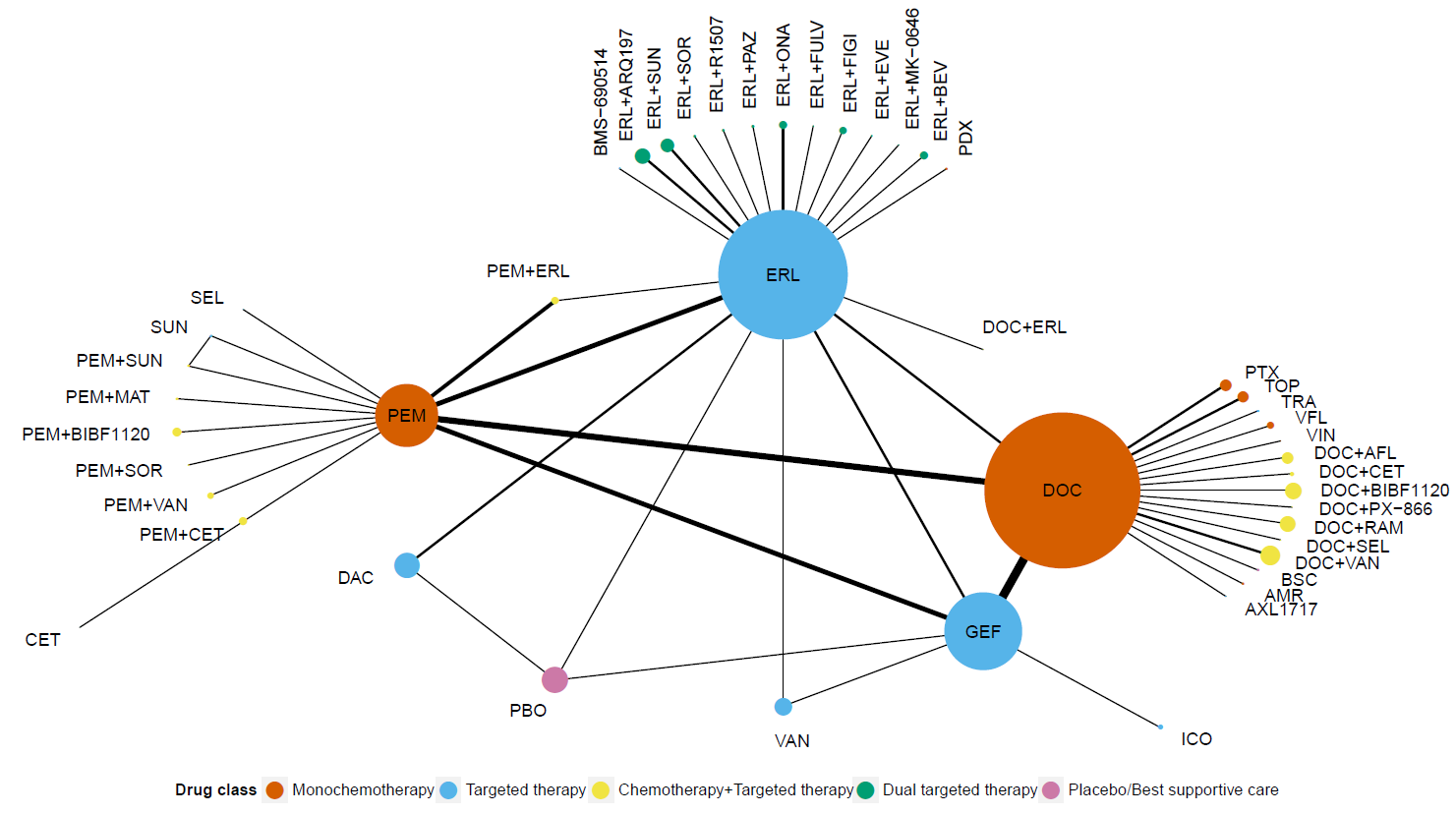
Network of trials
References :
Vandvik PO, Brignardello-Petersen R, Guyatt GH. Living cumulative network meta-analysis to reduce waste in research: A paradigmatic shift for systematic
reviews? BMC Med. 2016 Mar 29;14:59. doi: 10.1186/s12916-016-0596-4. PubMed PMID: 27025849; PubMed Central PMCID: PMC4812628.
Live cumulative network meta-analysis: protocol for second-line treatments in advanced non-small-cell lung cancer with wild-type or unknown status for epidermal growth factor receptor (see paper)
Principles of living NMA
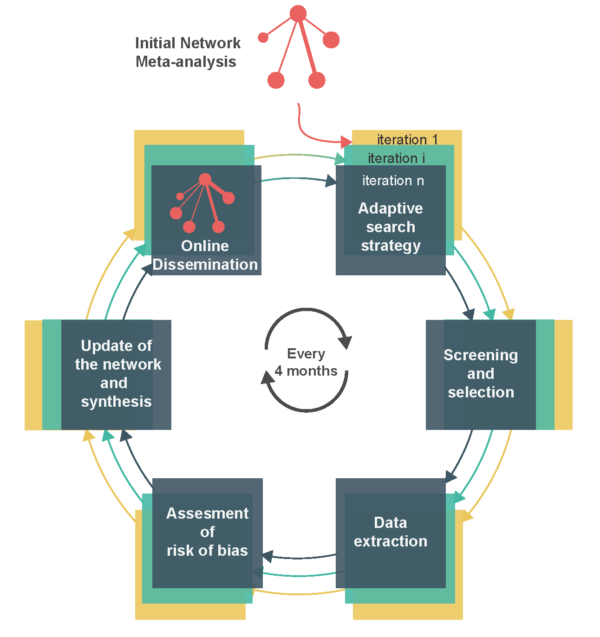
Adaptative search strategy
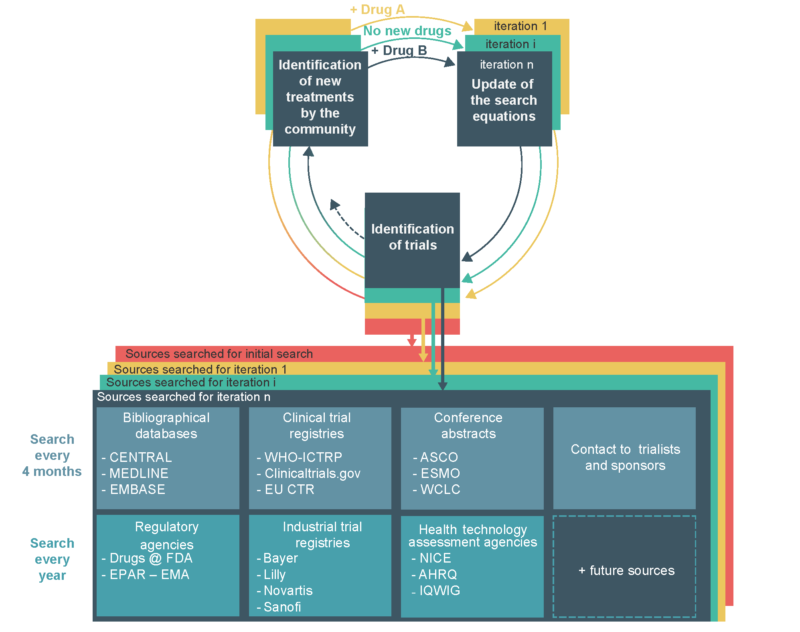
Research community
For a given condition, our proposal regarding the research community would be to involve different open groups of different skills. For instance, anyone interested in the condition targeted by the living NMA, including patients, would be able to spontaneously report new relevant treatments and trials. Experts in the given condition (clinicians, trialists or members of cooperative groups) from different countries would validate the methodological choices (e.g., selection criteria for populations, treatments and outcomes or subgroup analyses) and would be involved in the screening and selection of trials. Experts trained in systematic review methodology and experts in statistical methods would execute the core review steps.
Search strategy
See appendix 2 in the supplmentary file
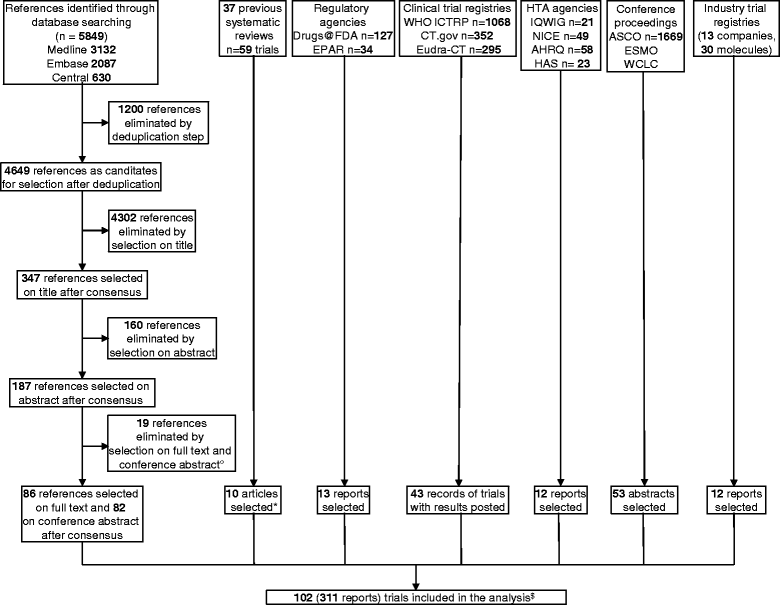
Flow chart: 102 trials (311 reports)
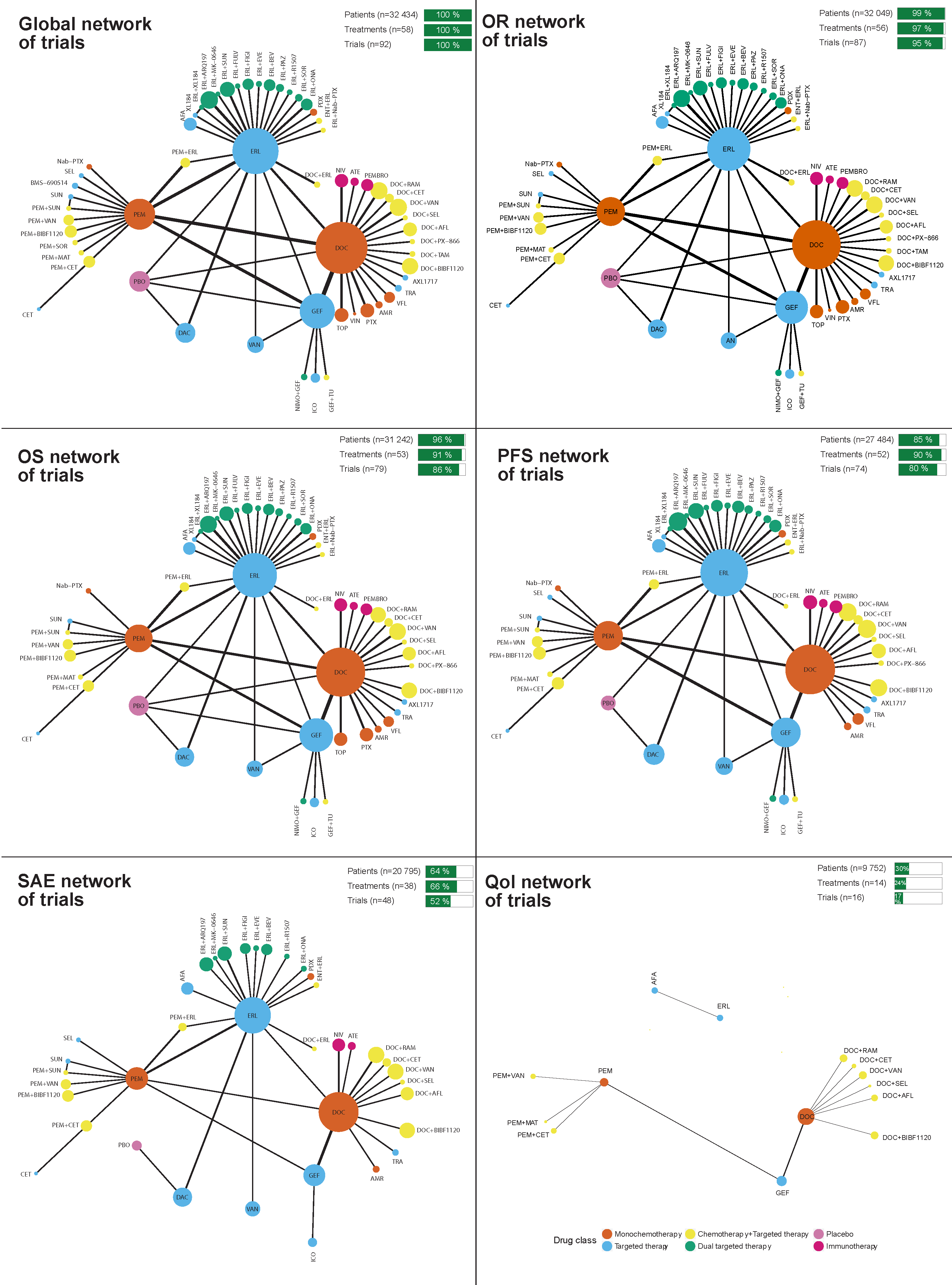
Networks of trials
List and characteristics of trials
See appendix 7 ans 8 in the supplmentary file
Results of individual trials
See appendix 9 in the supplmentary file
Risk of bias assessment for objective outcomes (OS) and subjective outcomes (PFS, ObR, SAE)
See appendix 4 in the supplmentary file
League tables for the main results
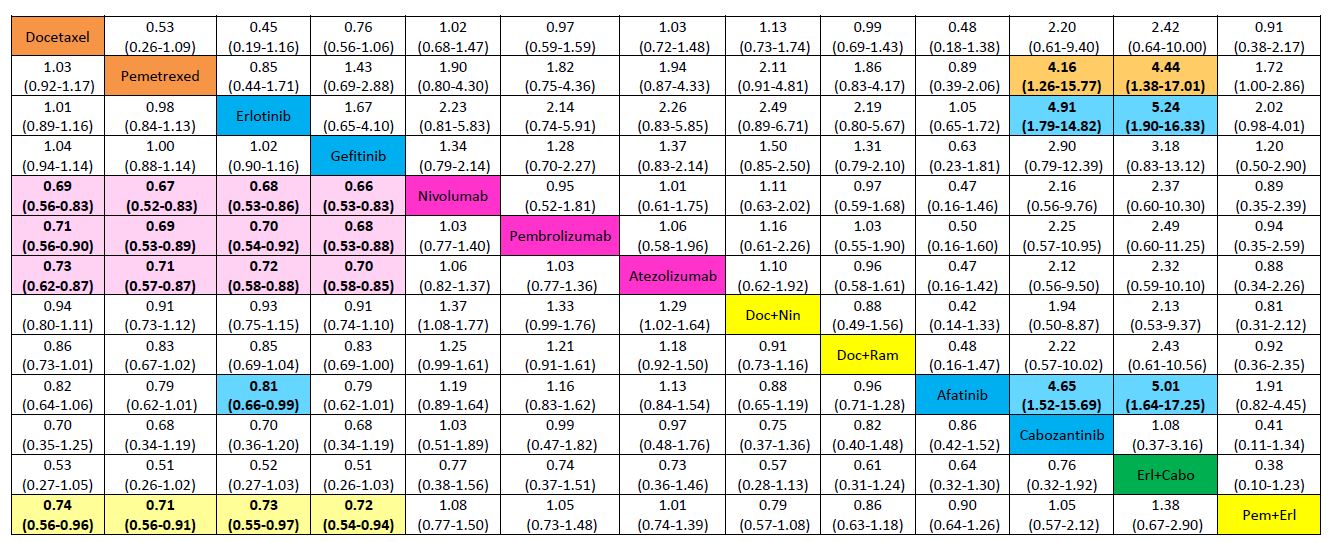
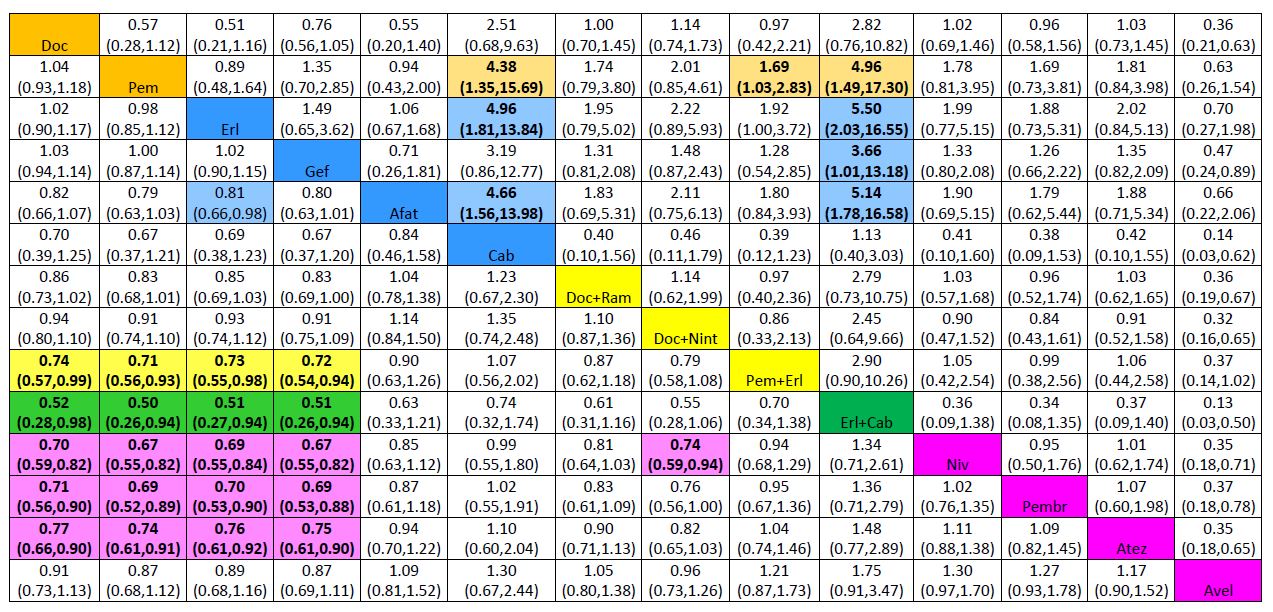
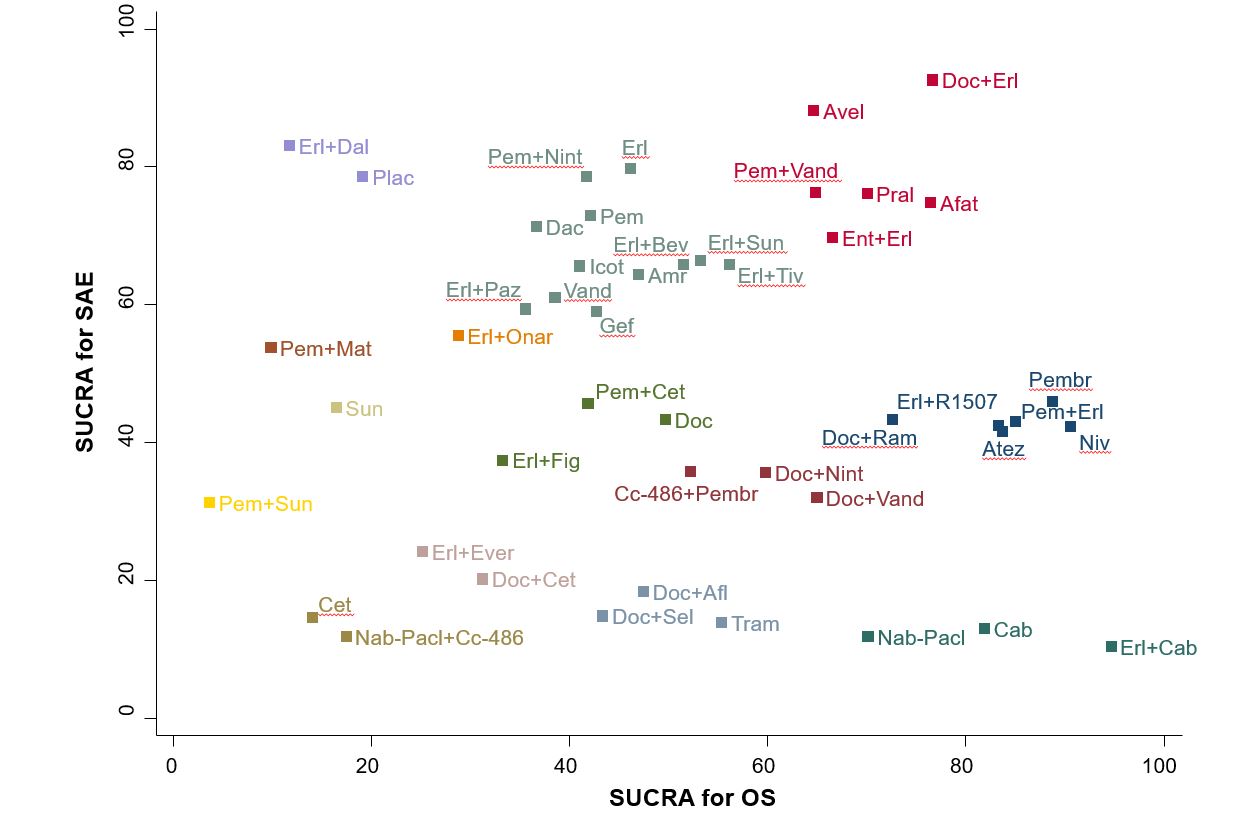
Hazard ratios (HRs) for overall survival (OS, lower triangle) and odds ratios for serious adverse events (SAEs, upper triangle) with their 95% credible intervals (95% CrIs) derived from network meta-analysis of 13 second-line treatments for NSCLC with wild-type or unknown status for EGFR
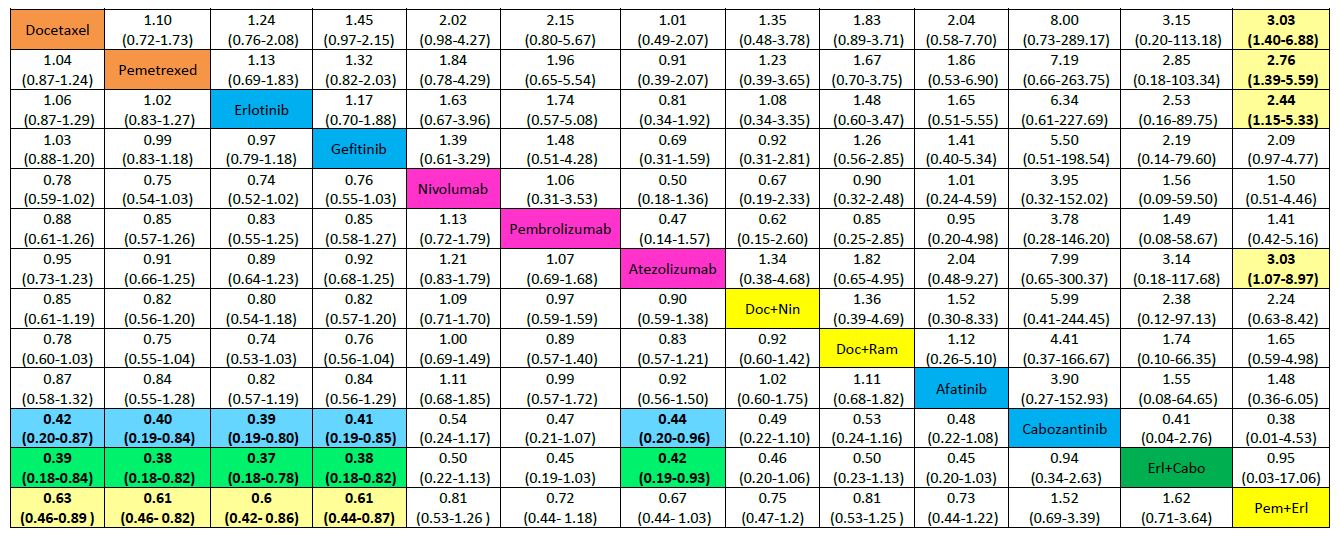
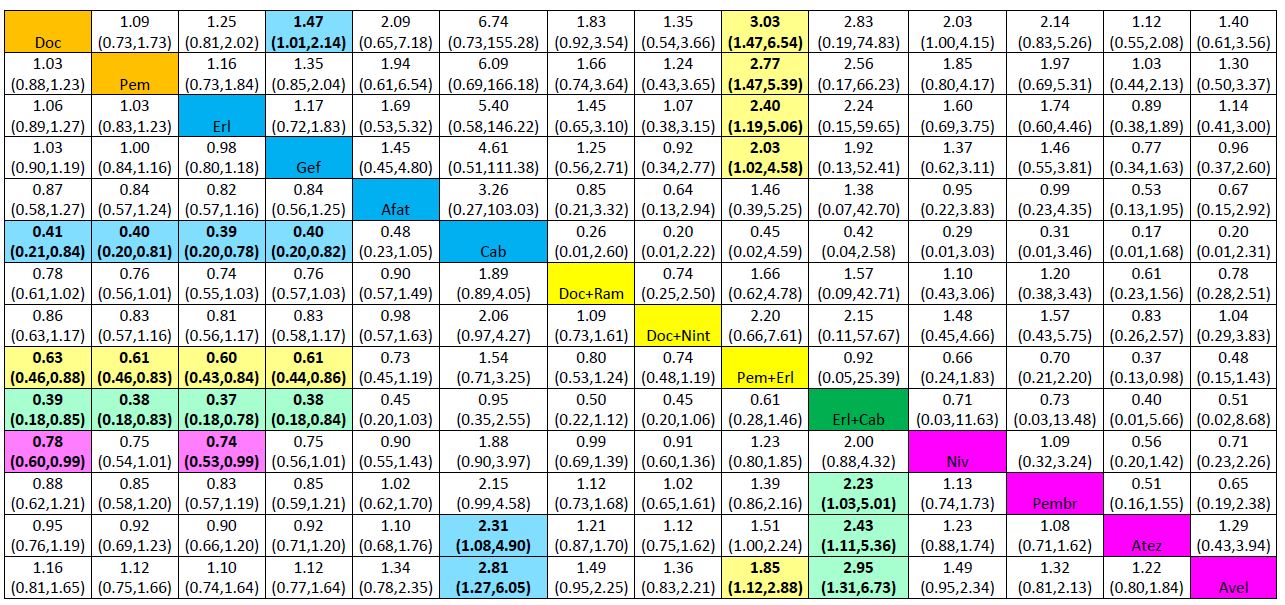
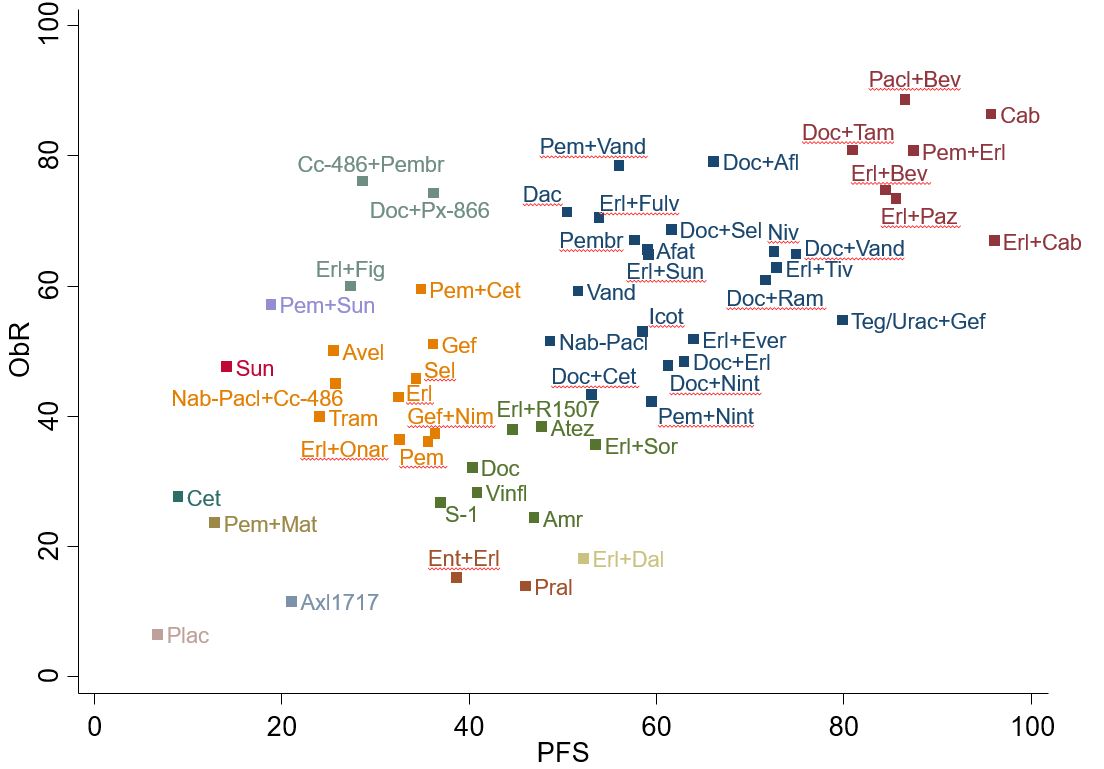
Hazard ratios (HRs) for progression-free survival (PFS, lower triangle) and odds ratios for objective response (ObR, upper triangle) with their 95% CrIs derived from network meta-analysis of 13 second-line treatments for NSCLC with wild-type or unknown status for EGFR

Results in figures:
See appendix 1 in the supplmentary file 3
Subgroups analyses:
See appendix 5 in the supplmentary file
References:
Créquit P, Chaimani A, Yavchitz A, Attiche N, Cadranel J, Trinquart L, Ravaud P. Comparative efficacy and safety of second-line treatments for advanced
non-small cell lung cancer with wild-type or unknown status for epidermal growth factor receptor: a systematic review and network meta-analysis. BMC Med. 2017 Oct 30;15(1):193. doi: 10.1186/s12916-017-0954-x. Review. PubMed PMID: 29082855; PubMed Central PMCID: PMC5662096.
Search strategy
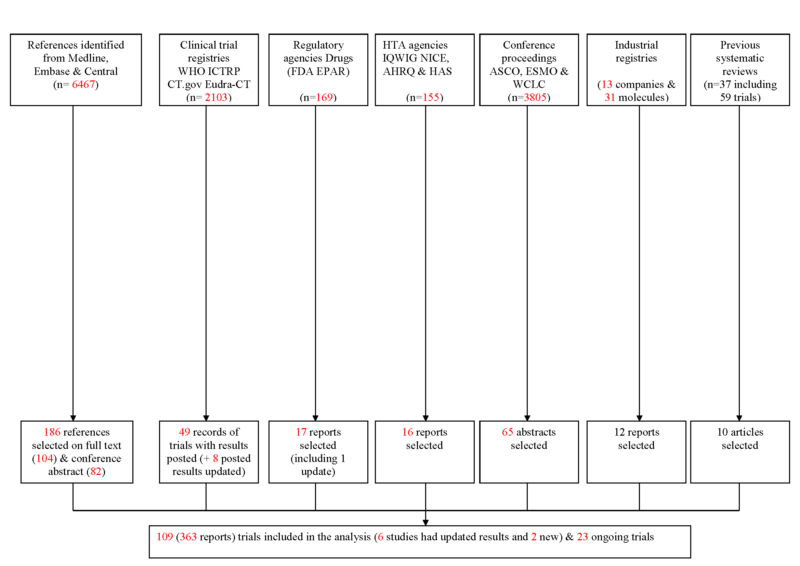
Flow chart: 109 trials (363 reports)
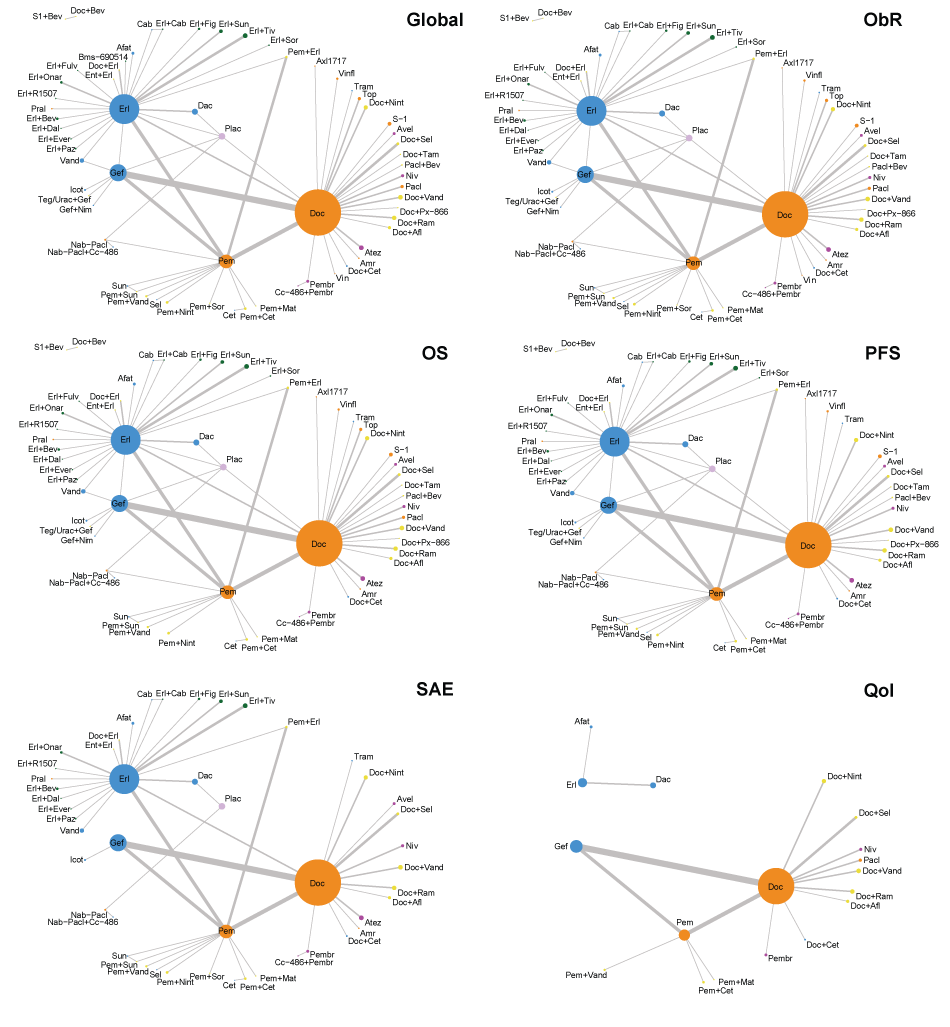
Networks of trials
List of trials
Characteristics of trials
Results of individual trials
Risk of bias assessment for objective outcomes (OS) and subjective outcomes (PFS, ObR, SAE)
League tables for the main results
Hazard ratios (HRs) for overall survival (OS, lower triangle) and odds ratios for serious adverse events (SAEs, upper triangle) with their 95% credible intervals (95% CrIs) derived from network meta-analysis of 13 second-line treatments for NSCLC with wild-type or unknown status for EGFR
Hazard ratios (HRs) for progression-free survival (PFS, lower triangle) and odds ratios for objective response (ObR, upper triangle) with their 95% CrIs derived from network meta-analysis of 13 second-line treatments for NSCLC with wild-type or unknown status for EGFR
Search strategy
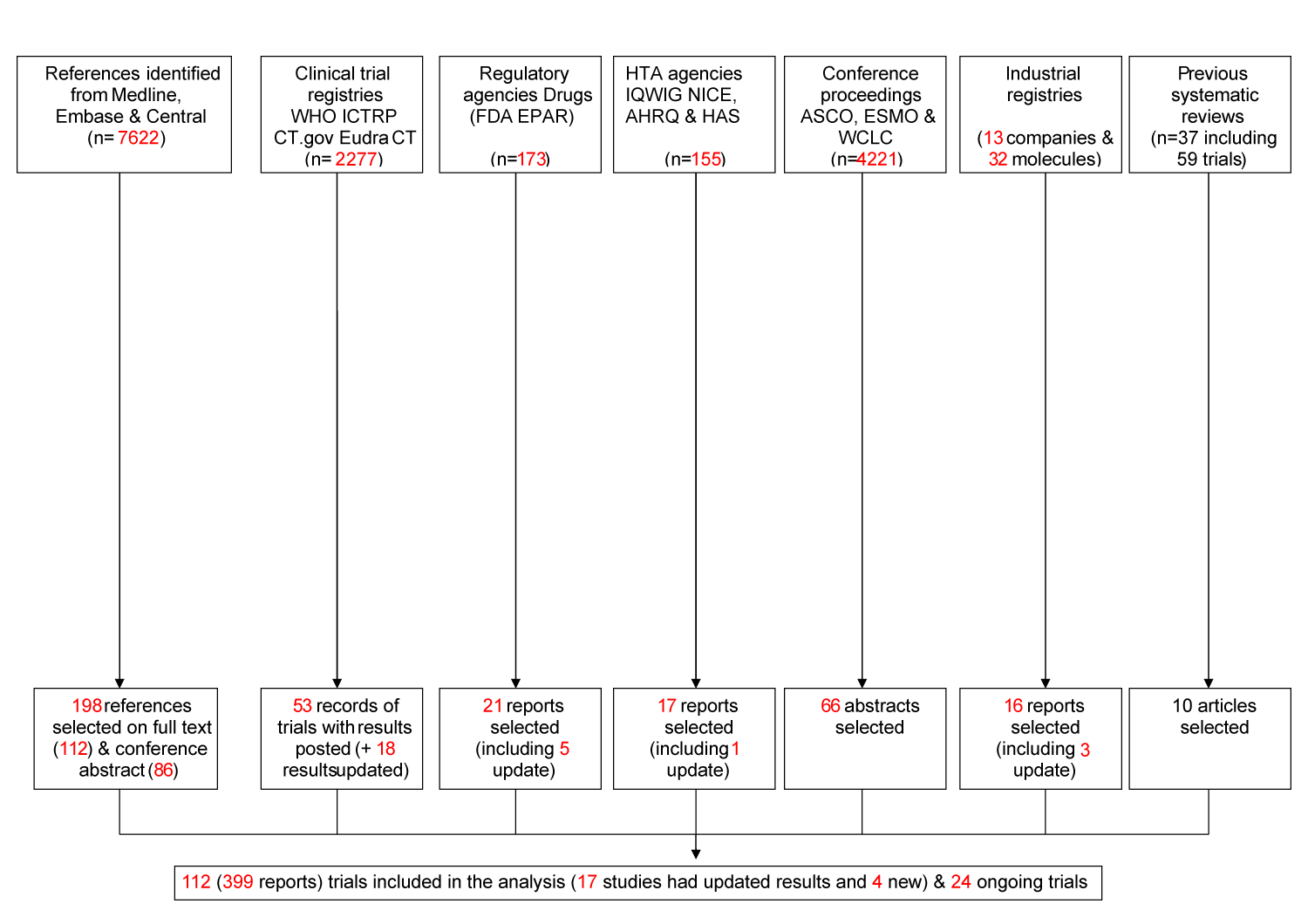
Flow chart: 112 trials (399 reports)
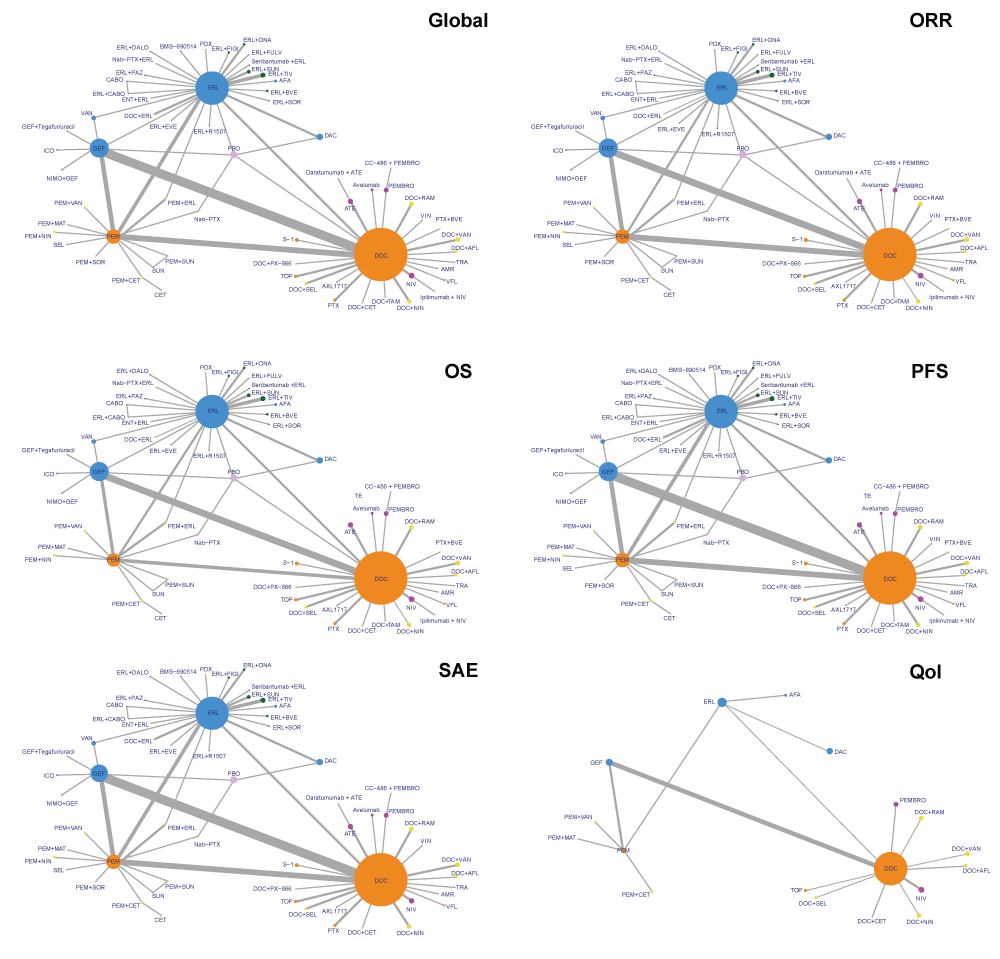
Networks of trials
List of trials
Characteristics of trials
Results of individual trials
Risk of bias assessment for objective outcomes (OS) and subjective outcomes (PFS, ObR, SAE)
League tables for the main results
In July 2019